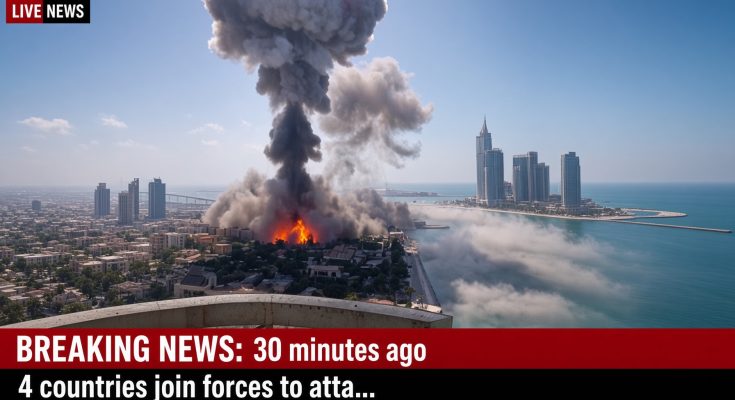
MANAMA, Bahrain — Mounting hostilities between Iran, the United States, and regional actors have pushed the Persian Gulf into an acute security crisis, directly exposing Gulf Cooperation Council (GCC) monarchies to retaliatory strikes, disrupting maritime traffic, and driving global crude prices past $100 per barrel. Bahrain, Qatar, Kuwait, and the United Arab Emirates find themselves on the front line of the confrontation. Because these nations host critical U.S. forward-operating installations and flank the world’s most vital energy choke point, the expanding exchange of missile barrages, drone swarms, and naval sabotage has placed their air-defense commands on highest alert. The conflict’s maritime dimension has escalated sharply. According to shipping data reported by Reuters, the week ending Oct. 5 saw the highest concentration of tanker-related incidents since regional hostilities erupted in February, with at least 12 verified attacks, attempted boardings, or hostile approaches recorded within seven days. Choke Point Under Siege The Strait of Hormuz—the maritime transit corridor that historically carries roughly a fifth of global petroleum liquids and vast liquefied natural gas shipments—has become the central economic battleground. Commercial tanker transit has plunged. By Oct. 6, daily commodity vessel passages dropped to just seven, the lowest 24-hour tally in over two months.
Crude flows plummeted to approximately 10.1 million barrels per day—roughly 74 percent of pre-conflict baselines. While regional producers have accelerated bypass pipeline flows where available, the maritime bottleneck has triggered sharp spikes in war-risk insurance premiums and unmoored benchmark energy futures. The United States has responded with persistent force projection. U.S. Central Command (CENTCOM), which maintains over 50,000 personnel throughout the theater, has conducted sequential air and naval strikes targeting Iranian surface-to-surface missile launch pads, drone staging depots, air-defense radars, and coastal command hubs. Washington maintains the operations are designed to degrade Tehran’s ability to interdict international commerce, but the continuous strikes have fueled retaliatory salvos aimed at Western assets in the region. GCC Hosts in the Crosshairs For the host nations, the presence of American bases presents an escalating defensive liability: United Arab Emirates: Operating in close proximity to Iranian coastal batteries, the UAE relies on a multi-tiered air-defense shield featuring Patriot and THAAD interceptors. However, military planners at Al Dhafra Air Base—a key hub for U.S. intelligence, surveillance, and combat sorties—face the constant threat of saturation attacks combining low-altitude loitering munitions with high-speed ballistic missiles designed to overwhelm defensive radars. Bahrain: As host to the operational headquarters of the U.S. Navy’s Fifth Fleet and Combined Maritime Forces, the island kingdom remains a high-profile target. Bahrain’s dense geography leaves civilian hubs, financial districts, and desalination facilities highly vulnerable to intercepted debris and near-miss strikes. Qatar: Al Udeid Air Base outside Doha functions as the logistical and operational command core for CENTCOM forward operations. Any kinetic disruption to the installation would hamper regional coalition coordination, forcing Qatari authorities to navigate complex diplomatic ties while securing critical offshore gas production. Kuwait: Bordering northern Gulf waters, Kuwait remains exposed to layered threats. Kuwaiti air defenses intercepted an Iranian ballistic missile in May, underscoring the risk of stray salvos and proxy drone incursions into Kuwaiti airspace.
Beyond immediate physical strikes, the economic toll is mounting across the Gulf. Flight paths across commercial aviation hubs in Dubai, Doha, and Abu Dhabi have been repeatedly altered to evade combat zones, adding costly transit hours. Ports face severe backlogs, and global logistics operators are increasingly re-evaluating risk models across the lower Gulf. The confrontation has left Gulf monarchies pursuing an uneasy balancing act: bolstering collective air defense and maintaining security partnerships with the United States while attempting to prevent an uncontrolled cycle of escalation from engulfing regional energy grids and commercial corridors. With diplomatic channels constrained and naval skirmishes multiplying around the Strait of Hormuz, the stability of the Gulf remains tied to an increasingly fragile margin of deterrence.