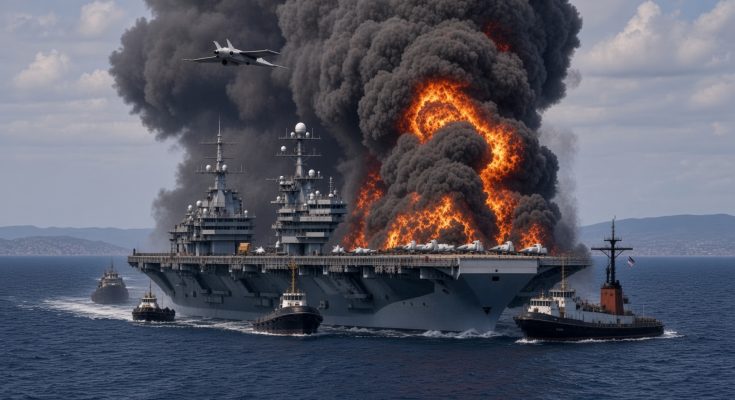
Reports circulating online have raised claims that a Russian Su-57 stealth fighter may have carried out a strike against a heavily protected naval vessel. However, the target’s identity, the location of the alleged attack, the extent of any damage and whether a Su-57 was involved have not been independently confirmed.
The lack of verifiable details has not prevented the story from attracting attention across social media
The claims have fueled speculation about the effectiveness of modern naval defense systems and the potential implications of an attack against a high-value military asset. Yet without confirmation from credible military sources or independent evidence, it remains unclear whether the reported incident occurred as described. where dramatic claims about advanced aircraft and naval warfare can spread rapidly before officials establish what happened. Questions Surround the Alleged Strike The reports describe a sudden attack against a fortified vessel, suggesting that its defensive systems were unable to stop the incoming threat. However, no independently verified information has established the vessel’s name, nationality, operational location or condition following the alleged incident.
There is also no confirmed evidence establishing the weapon allegedly used, the precise circumstances of the reported strike or whether any casualties occurred
These omissions are significant. Assessing a military attack requires more than an initial online claim. Investigators and defense analysts typically rely on multiple forms of evidence, including official statements, satellite imagery, verified video, geolocation analysis and credible reporting from sources with direct knowledge of the incident. Until such evidence becomes available, describing the vessel as destroyed or claiming that its defensive systems were decisively defeated would go beyond the established facts.
Developed by Russia’s Sukhoi design bureau
Russia’s Su-57 and Its Military Role The Russian Su-57 is a fifth-generation multirole combat aircraft designed to combine reduced radar observability with advanced sensors, onboard systems and the ability to engage air and ground targets. the aircraft is intended to operate in contested environments where air defenses and enemy aircraft can pose significant threats. Its design incorporates features intended to reduce its radar signature, although stealth does not make an aircraft invisible or invulnerable to detection. The Su-57’s capabilities have attracted international attention as Russia continues to develop and deploy advanced military technology. Nevertheless, evaluating the aircraft’s performance in a particular operation requires reliable evidence about the mission, the weapons involved and the conditions under which the aircraft operated.
Even if a strike involving the Su-57 were confirmed
the outcome would not automatically demonstrate that the aircraft could defeat every modern defensive system. Military engagements depend on numerous variables, including detection range, warning time, weapon characteristics, electronic warfare, the readiness of defending forces and the tactical circumstances of an attack. Modern Naval Defense Faces Multiple Challenges Modern warships may use layered defenses designed to detect, track and respond to incoming threats. Depending on the vessel and its mission, these systems can include radar, electronic warfare equipment, interceptor missiles and close-in weapons intended to engage threats at shorter distances. However, no defensive architecture can guarantee protection in every circumstance. The effectiveness of a ship’s defenses depends on the type of weapon approaching, the time available to respond, the number and direction of threats, and the condition and configuration of its systems.
Analysts would want to establish whether the vessel detected the incoming threat
A successful strike, if verified, would therefore require a careful examination of the circumstances rather than an immediate conclusion that modern naval defenses had become ineffective. whether defensive measures were activated and whether the weapon reached its target. They would also examine whether electronic interference, operational limitations or other factors played a role. At present, there is insufficient verified information to determine whether any of these factors were involved in the reported incident.
Information Gaps Fuel Online Speculation The spread of the claims illustrates the difficulties of assessing fast-moving military reports during periods of heightened international tension
Images and videos shared online can provide useful evidence, but they can also be old, incorrectly labeled or taken from unrelated events. Statements repeated across multiple accounts may appear to represent independent confirmation even when they originate from a single unverified source. For that reason, analysts generally seek corroboration before drawing conclusions about the outcome of a military operation. Official statements can help establish what governments acknowledge, while independent verification may be needed to assess competing accounts or claims that remain disputed.
The absence of confirmation does not, by itself, prove that an incident did not occur
It means that the details should remain unresolved until sufficient evidence becomes available. Potential Geopolitical Implications Remain Unclear If a major strike against a high-value naval vessel were confirmed, the incident could prompt questions about military readiness, force protection and the balance between offensive weapons and defensive technology. Its broader significance would depend heavily on the identity of the vessel, the location of the engagement, the parties involved and the circumstances surrounding the attack. An incident involving opposing forces in an active conflict could carry very different implications from an accident or an operation conducted during routine military activity.
For now, however, the available claims do not establish that a new military crisis has emerged or that the balance of power has shifted
Governments and defense organizations would need to assess verified evidence before determining whether operational changes or broader responses were warranted. Verification Remains Essential The reported Su-57 strike remains unconfirmed, and key questions about the alleged target, the weapon used and the outcome remain unanswered.
Until credible evidence establishes what happened
claims of catastrophic damage or a decisive failure of naval defenses should be treated cautiously. The aircraft’s capabilities and the vulnerabilities of modern warships are legitimate subjects for analysis, but conclusions about a specific engagement must rest on evidence rather than speculation. As additional information emerges, the central task will be to determine whether the incident occurred, identify the systems involved and establish its actual consequences. Only then will defense analysts be able to assess whether the reported event represents a significant military development or an unsubstantiated claim circulating online.