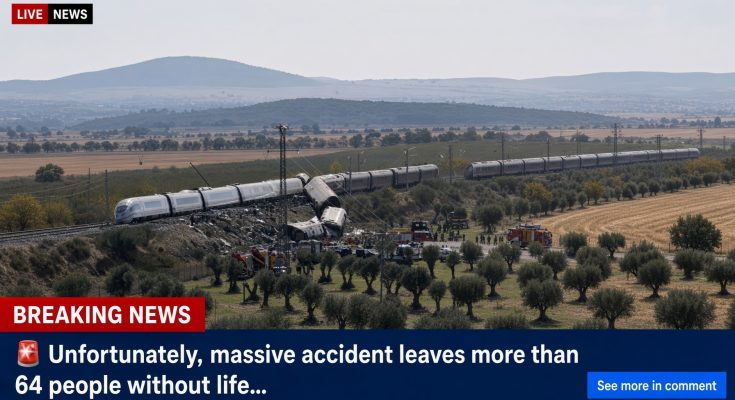
At least 64 dead after Spanish high-speed train derailment…
SANTIAGO DE COMPOSTELA, Spain — At least 64 passengers have died and dozens more have sustained severe injuries after a high-speed passenger train derailed along an approach bend outside the northwestern city of Santiago de Compostela, marking one of the deadliest rail disasters in modern European history.
Dozens of the injured remain hospitalized across regional trauma centers in critical condition
Emergency rescue workers, backed by military personnel and regional police, spent the night scouring the twisted wreckage with heavy cutting gear as cranes were brought in to shift crushed, charred railcars. Regional authorities confirmed the climbing casualty count early Thursday, warning that the figure could rise further as forensic teams work to access carriages that caught fire following the high-velocity impact. with medical directors issuing urgent public appeals for blood donations to support emergency surgical teams working through the night. A Catastrophic Derailment on Approach The service was carrying more than 200 passengers and crew when the train jumped the tracks roughly four kilometers short of the Santiago de Compostela station. The impact occurred along a pronounced curve known locally as A Grandeira, where tracks transition from high-speed line infrastructure into a conventional urban corridor requiring substantial deceleration.
Witness accounts and preliminary monitoring data describe a violent kinetic collision
The train’s forward carriages left the rails at speed, ramming a reinforced concrete retaining wall before the sheer momentum compressed subsequent cars like an accordion. One carriage vaulted over an embankment into an adjacent residential access road, while a secondary diesel-generator engine caught fire amid flying debris. Survivors described moments of calm suddenly replaced by extreme violence. “The train began rocking violently and within seconds, luggage, seats, and metal were flying everywhere,” one passenger told local radio reporters after being pulled from a rear window. “Everything went black, filled with thick smoke, and people were screaming for exits that were completely crushed shut.”
Local residents living along the rail cutting were the first on the scene
rushing down with blankets, crowbars, and hoses to pull dazed, injured travelers through ruptured windows before municipal firefighters and mobile intensive care units arrived in force. Inquiries Center on Excessive Velocity Judicial authorities and Spain’s rail accident investigation commission (CIAF) have formally opened a multi-track safety and criminal inquiry to isolate the catalysts behind the catastrophe. While technical investigators emphasize that all causal factors—including mechanical failure, railbed integrity, and signaling anomalies—will be thoroughly reviewed, primary scrutiny has settled immediately on excessive operational speed:
Onboard Telemetry and Black Boxes
Curve Speed Limits: The segment where the derailment occurred carries a strict maximum operating limit of 80 kilometers per hour (50 mph), a sharp reduction from the 200 km/h (124 mph) permitted on the preceding high-speed straightaways. Forensic technicians have secured the train’s data-event recorders to reconstruct exact brake-application timings, engine throttle positions, and emergency cab communications in the moments before the cars overturned. Signaling Architecture: Safety analysts are examining whether trackside beacon-assisted braking systems failed to engage or whether the driver failed to respond to cautionary signals approaching the urban speed-reduction zone.
National Shock and Regional Mourning The crash struck on the eve of the historic Feast of St
Regional judicial officials confirmed that the driver survived the impact with non-life-threatening injuries and has been placed under formal judicial supervision in a local clinic pending initial interrogations. James, Galicia’s most significant cultural and religious celebration. The annual festival routinely draws thousands of pilgrims, tourists, and returning families from across Spain and abroad to Santiago de Compostela’s historic cathedral square. Following an emergency cabinet briefing, regional government leaders immediately suspended all public celebrations, declaring an official period of regional mourning. Spain’s prime minister and senior transport officials arrived on site Thursday morning to inspect the damage, meet with first responders, and visit triage centers established at a nearby municipal indoor stadium where families of the missing continue to await formal identification updates.
As heavy machinery lifts the final derailed carriages from the trackbed
the disaster has prompted renewed calls for immediate reviews of automated speed-enforcement standards across transition zones where high-speed lines intersect legacy urban rail networks.