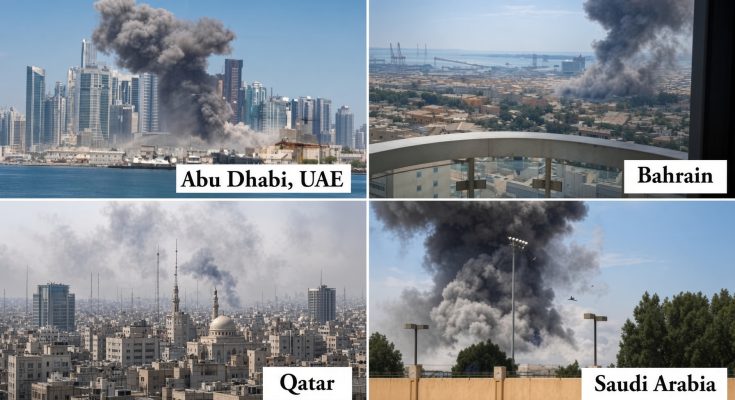
DUBAI — A persistent drumbeat of Iranian ballistic missile and one-way attack drone salvos has locked the Persian Gulf onto an active war footing, turning the strategic waterway into a high-intensity battleground and testing the limits of regional missile-defense architecture. What began as calibrated, reciprocal posturing has metastasized into a theater-wide conflict spanning sovereign borders across the Arabian Peninsula. Direct strikes targeting major logistical hubs, airfields, and command facilities hosting American forces in Bahrain, Qatar, Kuwait, and the United Arab Emirates have dismantled the assumption that the littoral states could insulate themselves from direct kinetic exchanges between Washington and Tehran. With tens of thousands of U.S. service members stationed alongside allied Gulf armies across the theater, every incoming salvo threatens to puncture defensive umbrellas and catalyze an uncontrolled escalatory cycle. Interceptors Strained Over the Emirates In the United Arab Emirates, elite air-defense units have repeatedly engaged incoming threats after early-warning sensors detected ballistic trajectories and autonomous loitering munitions crossing the maritime boundary.
Although layered batteries—anchored by U.S.-manufactured Patriot PAC-3 systems and advanced Terminal High Altitude Area Defense (THAAD) units—have downed dozens of projectiles before reaching urban population centers, defense networks are operating near continuous depletion thresholds. The primary point of friction remains Al Dhafra Air Base, situated south of Abu Dhabi. Long serving as the regional operational hub for coalition aerial reconnaissance, airborne early warning, and tactical strike wings, the sprawling airfield has become a prime target in Iranian contingency planning. While state-run media in Tehran has claimed significant damage to hangars and runway networks, regional defense ministries and Pentagon officials have maintained strict operational silence, withholding specific damage metrics pending comprehensive battle damage assessments. Nonetheless, defense analysts note that Al Dhafra’s vulnerability exposes the strategic dilemma confronting host nations whose economic hubs sit directly beneath the flight paths of incoming ordinance. Forward Garrisons in the Crosshairs The threat arc spans the entire length of the Persian Gulf, leaving forward commands exposed to saturated missile profiles: Bahrain’s Strategic Anchorage: In Manama, Naval Support Activity Bahrain—the operational nerve center for U.S. Naval Forces Central Command and the forward headquarters of the U.S. Fifth Fleet—remains on maximum readiness posture.
Interceptor batteries across the island kingdom have engaged incoming tracks seeking to target maritime support infrastructure, while military outposts in the southern Sheikh Isa sector have confronted repeated drone incursions. Qatar’s Forward Command Nerve Center: Al Udeid Air Base, situated southwest of Doha, houses the Combined Air Operations Center and the forward command element of U.S. Central Command (CENTCOM). Commercial high-resolution satellite imagery has confirmed physical degradation to auxiliary maintenance structures following recent rounds of saturation attacks, demonstrating that even heavily fortified garrisons face persistent leakages through air-defense curtains. Kuwait’s Frontline Outposts: In the north, Camp Buehring and Ali Al Salem Air Base have absorbed continuous loitering munition waves. Kuwaiti armed forces have repeatedly scrambled ground-based defenses to counter low-altitude radar-evading targets as warning sirens routinely disrupt commercial logistics hubs and strategic hydrocarbon terminals near the border.
These coordinated barrages demonstrate a clear tactical doctrine: by holding American military infrastructure hostage across four separate Gulf Cooperation Council states, Tehran is attempting to impose unsustainable operational costs on regional hosts while degrading allied early-warning integration. The Chokepoint Dilemma at Hormuz Beyond hardened military perimeters, the kinetic exchanges have severely destabilized the Strait of Hormuz, the narrow maritime transit corridor handling roughly one-fifth of global petroleum flows and essential liquefied natural gas shipments. Fast-attack littoral craft operated by the Islamic Revolutionary Guard Corps Navy, paired with anti-ship cruise missile emplacements and low-flying drone attacks, have turned the maritime corridor into a perilous gauntlet. Commercial container carriers and supertankers have faced structural damage, hull fires, and electronic warfare spoofing, forcing major maritime operators to reroute vessels around the Cape of Good Hope. The disruption has prompted a dramatic surge in war-risk insurance premiums, compounding transit expenses and threatening global supply chains. Commodity market trackers and international energy indices indicate sharp price fluctuations in crude oil with each reported naval exchange.
Economists warn that any sustained or total closure of the chokepoint risks setting off systemic energy inflation and cascading logistical failures worldwide. The Shrinking Window for De-escalation For forward-deployed American commands and regional military leadership, day-to-day operations have narrowed to hardened force protection, continuous battery reloading, and damage mitigation. Yet military strategists warn that interceptor stockpiles are mathematically limited; an aggressive, sustained campaign of cheap suicide drones combined with multi-stage ballistic missiles can eventually overwhelm interceptor capacity through sheer saturation. The strategic landscape across the Persian Gulf is now governed by hair-trigger alerts. With major cities, petrochemical refineries, and foreign military bases clustered within minutes of Iranian coastal launch corridors, a single failed intercept or high-casualty strike could eliminate what remains of diplomatic mediation, plunging the entire region into an open-ended, multi-theater war.