Leavitt Sets Media Straight With Fact-Check On Joe Biden…
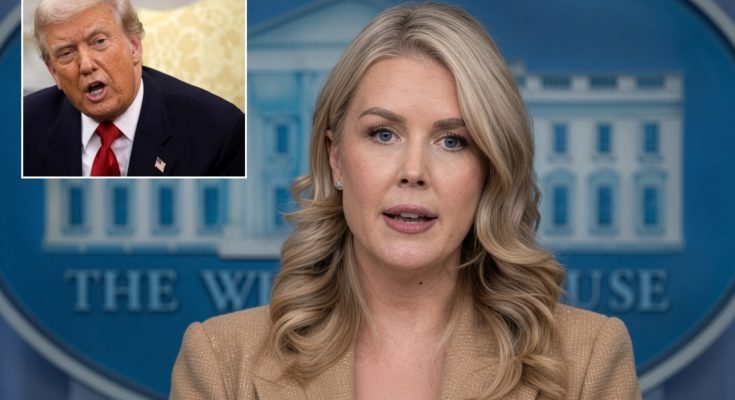
WASHINGTON — White House Press Secretary Karoline Leavitt mounted a fierce defense of the administration’s overhaul of executive press access during a media forum, contrasting President Donald Trump’s high-volume public engagements with what she characterized as former President Joe Biden’s deliberate avoidance of the press corps.
Speaking at an event hosted by Axios co-founder Mike Allen
Leavitt pushed back against criticism surrounding recent adjustments to the structure of the White House traveling press pool. She argued that reallocating pool access dilutes an entrenched legacy media cartel and expands opportunities for digital and non-traditional outlets. The exchange escalated when Allen questioned whether the administration’s curbs on legacy institutions—such as the Associated Press, which historically held dedicated rotating pool seats—risked compromising historical coverage. Allen cited the iconic image of Trump pumping his fist following the July 2024 assassination attempt in Butler, Pennsylvania, captured by AP chief photographer Evan Vucci, as an example of why wire service presence remains vital. “I don’t view them as restrictions,” Leavitt responded. “We view them as opening access to more outlets, more voices, more news journalists and outlets. We shouldn’t have a few outlets who have a monopoly over the briefing room or over that 13-person press pool that covers the president.”
A Clash Over Pool Governance The traditional 13-member White House press pool
with trailing the president into tight spaces, including the Oval Office, Marine One, and Air Force One—has long been coordinated under the auspices of the White House Correspondents’ Association (WHCA). The association has historically guaranteed seats to wire services, major television networks, and select print organizations to ensure continuous, non-partisan pool reporting. When Allen referenced the WHCA’s position that governments must not dictate or curate the independent press corps that covers them, Leavitt directly challenged the association’s authority. “I think that a small group of journalists who comprise the board of the White House Correspondents’ Association should not dictate who gets to go into the Oval Office and who gets to ride on Air Force One,” Leavitt said. “There should be equal access for all outlets.”
Leavitt dismissed accusations that the pool restructuring was designed to engineer favorable coverage, arguing that critical legacy organizations continue to receive credentials
“If we were trying to make it easier on him or on the administration, we wouldn’t allow some of these fake news leftist outlets in. But we continue to do that,” she said. “No one has been restricted. We’ve just given more spots to more outlets and more voices. It’s not about ideology.” The Transparency Metric: Trump Versus Biden To substantiate her case, Leavitt pointed to comparative data on executive media availability. Historically, the Trump White House has favored frequent, unscripted exchanges with reporters on airport tarmacs, helicopter departures, and open press spray settings, whereas the Biden administration maintained a tightly managed media posture.
According to historical media tracking metrics compiled by Axios
Biden logged the fewest formal press conferences and media interviews of any modern American president across a comparable period in his term: Donald Trump: 468 total press conferences and formal interviews conducted during a parallel timeframe. Joe Biden: 164 total interactions, ranking lowest among the past seven commanders-in-chief.
George W. Bush: 248 total interactions
Ronald Reagan: 262 total interactions. Leavitt framed the contrast as proof that access cannot be measured solely through the traditional institutional privileges granted to legacy organizations. She asserted that despite media criticisms of the revised rotation system, public visibility into executive operations remains robust because independent journalists maintain an active daily presence inside the briefing room.
Modernizing Executive Coverage The policy overhaul mirrors Trump’s broader strategic embrace of modern
fragmented media platforms over legacy networks and print stalwarts. Throughout his 2024 presidential campaign, Trump leaned heavily into long-form digital podcasts, streaming broadcasts, and independent online channels to bypass traditional journalistic intermediaries and mobilize the electorate directly. Leavitt noted that the White House considers it an administrative priority to reflect those technological shifts in government communications. “We live in a digital age, and we’re recognizing that at the White House,” Leavitt said. “The president ran a non-traditional media campaign, which propelled him back to the highest office in the land. And we felt it was our responsibility to continue that in our coverage at the White House.”