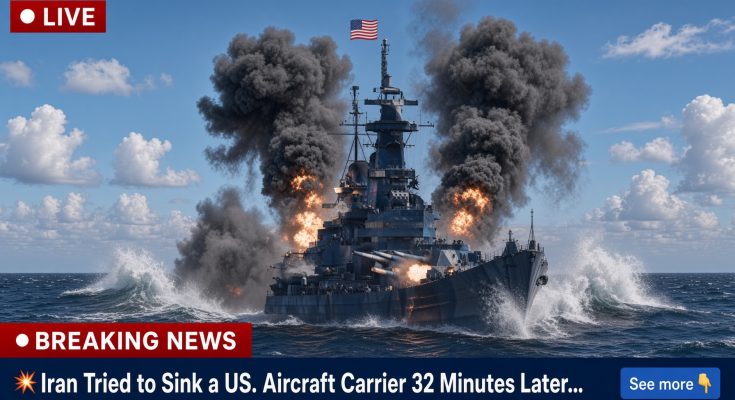
U.S. Forces Reportedly Strike Iranian Vessel Near USS Abraham Lincoln…
WASHINGTON — A confrontation between U.S. and Iranian naval forces in regional waters escalated into a live-fire engagement after an Iranian surface vessel closed within hazardous proximity of the aircraft carrier USS Abraham Lincoln, according to two U.S. defense officials familiar with the preliminary operational reporting.
The incident marks one of the most volatile direct engagements between American and Iranian forces in recent months
The encounter culminated in an American military helicopter striking the intruding vessel with two AGM-114 Hellfire precision-guided missiles after deck guns aboard an escorting surface combatant failed to neutralize the threat, the officials said, speaking on condition of anonymity to discuss sensitive military operations. underscoring the elevated hair-trigger environment across vital Middle Eastern maritime corridors. A Tiered Tactical Response According to the officials, the Iranian craft initiated a high-speed approach toward the Abraham Lincoln’s defensive screen, ignoring standardized radio challenges, acoustic warnings, and visual flares intended to deter approaching traffic.
As the vessel continued to close the distance
In response, an American surface combatant assigned to the carrier strike group brought its 5-inch Mark 45 lightweight naval gun to bear. The warship fired multiple rounds toward the approaching vessel, though none scored direct hits. It remains operationally ambiguous whether the crew fired the 5-inch munitions as deliberate warning shots across the vessel’s bow or as an uncorrected kinetic barrage to disable the craft’s propulsion. strike group watchstanders scrambled an armed naval helicopter—typically an MH-60R Seahawk configured for surface warfare—to interdict. The helicopter crew engaged the target directly, firing two Hellfire missiles in rapid succession. Both munitions struck the craft. Neither the Pentagon nor Iranian state authorities have released battle-damage assessments detailing the condition of the vessel or confirming casualties among its crew. It remains unclear whether the stricken boat sank or remained adrift.
Fortified Strike Group Operations The USS Abraham Lincoln serves as the flagship of Carrier Strike Group 3
operating in the U. S. Central Command (CENTCOM) area of responsibility to deter asymmetric maritime threats and safeguard international shipping routes. A standard carrier air wing represents a massive projection of air superiority, but the capital ship itself relies on concentric rings of defensive escorts. Cruising alongside the Lincoln are guided-missile destroyers, including the USS Spruance and USS Michael Murphy, warships equipped with the Aegis Combat System, vertical launch cells, and close-in weapons systems engineered to intercept both asymmetric swarming boats and advanced anti-ship cruise missiles. Approaching an aircraft carrier within close visual range violates established maritime safety protocols and forces American commanders to make split-second calculations regarding intent, particularly given the persistent regional threat posed by remote-controlled explosive-laden drone boats.
While the Mark 45 cannon is designed to deliver rapid
U. S. Central Command has not formally confirmed the engagement, and Department of Defense spokespersons declined to provide on-the-record details regarding the timeline, the specific escort ship that fired the Mark 45 cannon, or the operational status of the targeted crew. Technical Precision and Escalation Hazards The transition from a 5-inch naval deck gun to airborne Hellfire missiles illustrates the rapid operational escalation available to carrier air wings when confronting littoral threats. radar-directed fire against surface and shore targets, high-speed maneuvering by small surface craft in rolling seas can complicate manual and semi-automated fire control solutions. By contrast, the laser-guided AGM-114 Hellfire delivers pinpoint terminal accuracy, making rotary-wing platforms the primary counter-swarm asset in the Navy’s defensive playbook.
The tactical engagement arrives amid sustained regional friction
where routine patrols in the Persian Gulf, the Strait of Hormuz, and the Arabian Sea frequently run parallel to Iranian Islamic Revolutionary Guard Corps Navy (IRGCN) assets. American defense officials have consistently condemned unsafe and unprofessional maneuvers by Iranian craft, noting that aggressive posturing exponentially heightens the probability of lethal miscalculation. The strike group’s chain of command is reviewing sensor telemetry, radar tracking data, and cockpit camera feeds to reconstruct the precise sequence of events. With both nations locked in a protracted geopolitical standoff, the clash highlights how quickly routine maritime surveillance operations can deteriorate into kinetic conflict in crowded regional waterways.