Trump Claims Iranian Supreme Leader Is “90% Gone” After Heavy U.S. Strikes…
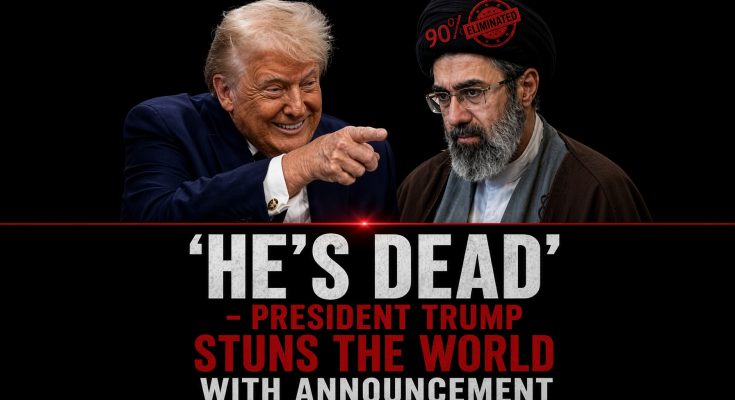
WASHINGTON — President Donald Trump claimed that Iran’s Supreme Leader, Mojtaba Khamenei, is “90% gone” following an extensive wave of U.S. military strikes, offering an unverified assessment of the cleric’s physical condition amid a sharp escalation in hostilities between Washington and Tehran.
An Unverified Claim Amid Wartime Fog Speaking to reporters
The remarks, delivered as the Pentagon continues high-intensity operations targeting strategic Iranian assets, represent the most direct assertion by an American president regarding the vulnerability of Iran’s top leadership. Yet the claim immediately confronted an intelligence vacuum: independent observers, international monitors, and allied intelligence agencies have not corroborated the assertion, and Tehran has maintained strict silence regarding the supreme leader’s whereabouts and well-being. Trump framed the operation as a decisive blow to the command hierarchy of the Islamic Republic, asserting that recent bombardments had pushed the supreme leader to the brink. “He is 90% gone,” Trump said, without detailing whether his assessment relied on battle-damage assessments, signals intelligence, or human sources within Tehran.
The White House did not provide underlying evidence to support the characterization
Iranian state-aligned outlets and official spokespersons have not acknowledged any casualty or incapacitation involving Khamenei, instead broadcasting standard programming interspersed with official condemnations of foreign aggression. In active combat theaters, claims of high-profile leadership decapitation are notoriously difficult to verify swiftly. Independent analysts caution that political rhetoric often outpaces corroborated intelligence during initial post-strike evaluations, leaving the supreme leader’s precise operational status unconfirmed. Systematic Strikes on Strategic Infrastructure The claim follows what defense officials describe as a targeted campaign designed to dismantle Tehran’s offensive projection and defensive perimeter. American sorties and standoff munitions have struck heavily fortified installations across the country, prioritizing:
Integrated Air-Defense Networks: Neutralizing early-warning radar arrays and surface-to-air missile batteries to secure air superiority
Ballistic and Cruise Missile Arsenals: Striking subterranean launch silos, manufacturing centers, and stockpiles positioned across western and central Iran. Command and Control Nodes: Targeting fortified communication bunkers linked to the Islamic Revolutionary Guard Corps (IRGC) leadership.
Administration officials have argued that the operational focus is preventative, aimed at crippling Tehran’s ability to coordinate asymmetric responses against forward-deployed U. S. forces, regional partners, and commercial shipping lanes. The full physical and strategic toll of the strikes, however, remains difficult to verify independently as smoke clears over contested sites and Iranian authorities restrict foreign media access. Succession and Governance at a Crossroads Trump’s assertion has accelerated acute geopolitical scrutiny of Iran’s domestic stability. In the institutional structure of the Islamic Republic, the supreme leader exercises ultimate command over the armed forces, dictates foreign policy, and serves as the ultimate arbiter between rival political factions.
The sudden incapacitation or demise of the supreme leader would trigger an unprecedented constitutional and political test
Under the Iranian constitution, the Assembly of Experts is tasked with selecting a successor, though any transition occurring under foreign bombardment would likely elevate the IRGC’s domestic dominance, transforming the succession into a contest for regime survival. Diplomats warn that a leadership vacuum could complicate backchannel communication. Without a definitive authority capable of sanctioning a diplomatic pause, decentralized command structures may pursue retaliatory escalation independently, compounding the risk of miscalculation across multiple fronts. Volatility in Global Energy and Maritime Corridors The military campaign and subsequent leadership uncertainty have rattled international energy markets and maritime logistics. Commercial carriers navigating the Persian Gulf and the Strait of Hormuz—the vital chokepoint through which roughly a fifth of the world’s petroleum passes—have implemented emergency security protocols. War-risk insurance premiums have surged, prompting some major operators to reroute tankers around southern Africa.
While Washington maintains that preserving freedom of navigation and protecting regional allies remain non-negotiable objectives
regional capitals have expressed alarm over unchecked escalation. Gulf states, caught in the geographic crossfire, have intensified diplomatic outreach, urging de-escalation while quietly reinforcing their own civil-defense architectures. For now, the strategic landscape remains dictated by uncertainty. As allied intelligence analysts sift through satellite reconnaissance and intercepted communications, the veracity of Washington’s claims—and the resilience of Tehran’s command apparatus—will determine whether the confrontation stabilizes into a volatile standoff or expands into a regional conflagration.