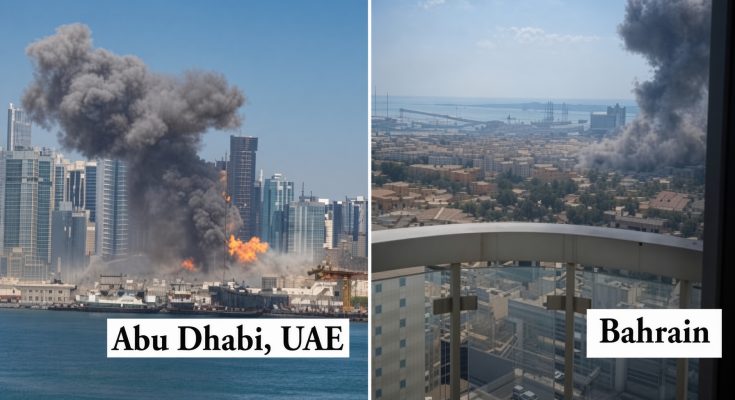
BREAKING NEWS: IRANIAN MISSILE, DRONE ATTACKS TARGET U.S. HUBS…
DUBAI / WASHINGTON — The Persian Gulf has returned to a volatile war footing following coordinated waves of Iranian missile and drone strikes aimed at facilities hosting U.S. forces, pushing regional air defense networks to their limits and fracturing hopes that the confrontation could remain geographically contained.
Across multiple Gulf Cooperation Council (GCC) capitals
emergency sirens sounded and multi-layered air defense batteries activated overnight as Tehran widened its cross-border offensive. The synchronized strikes targeted critical logistics, air, and naval hubs spanning the United Arab Emirates, Bahrain, Qatar, and Kuwait, underscoring the acute exposure of host nations caught between Washington’s military footprint and Iranian retaliation. Gulf Hubs Under Direct Fire In the United Arab Emirates, security forces were placed on maximum alert following loud detonations and verified incoming aerial vectors. Interceptor systems engaged targets over several sectors, with attention focused squarely on Al Dhafra Air Base south of Abu Dhabi. The installation serves as a linchpin for American aerial reconnaissance, refueling, and strike capabilities. While Iranian state-aligned outlets claimed extensive hits on U. S. -linked assets, regional defense officials urged caution, stating that comprehensive battle damage assessments are ongoing and that several projectiles were brought down before reaching base perimeters. To the northwest, Bahrain faced renewed security lockdowns. The island kingdom hosts Naval Support Activity Bahrain, the operational headquarters of U. S. Naval Forces Central Command and the U. S. Fifth Fleet. Given its role directing maritime security and carrier strike group coordination across the Arabian Sea, Bahrain represents one of the highest-value nodes in Washington’s regional architecture. Intercepts were reported in the vicinity of Sheikh Isa Air Base, where authorities confirmed incoming threats were neutralized, though local populations braced for secondary strikes.
Similar operational strains hit Qatar and Kuwait
Al Udeid Air Base (Qatar): As the forward headquarters of U. S. Central Command (CENTCOM), Al Udeid remains the central nerve center for coalition air operations. Previous barrages have triggered rapid dispersal protocols, with satellite intelligence previously confirming minor fragmentation damage to outer perimeter infrastructure. Kuwait Operational Zones: Kuwaiti air defense units tracked and engaged multiple low-flying uncrewed aerial vehicles (UAVs) directed toward shared facilities, reinforcing the vulnerability of northern Gulf logistics corridors adjacent to southern Iraq.
The strikes highlight a systematic shift in Tehran’s operational doctrine
utilizing saturation tactics—combining one-way attack drones with ballistic and cruise missiles—to test the magazine depth and radar coordination of integrated Gulf air defenses. Maritime Chokepoints and Energy Shocks Beyond the immediate tactical toll on base infrastructure, the escalation casts a severe shadow over global trade routes, most notably the Strait of Hormuz. The narrow maritime artery handles roughly one-fifth of global petroleum consumption, alongside vast flows of liquefied natural gas (LNG) originating from Qatar and the UAE. Commercial maritime traffic through the corridor has begun slowing, with international shipping syndicates issuing urgent security advisories. Marine insurers have dramatically widened exclusion zones and spiked war-risk premiums, prompting several major tanker operators to pause transits through the lower Gulf. Energy analysts warn that any sustained disruption—whether via direct missile impacts, sea-mining operations, or ship seizures—threatens immediate shocks to international crude benchmarks and fragile global inflation curves.
The Peril of the Next Salvo For Gulf partners
the strikes illustrate a long-feared geopolitical dilemma: absorbing direct strikes aimed at American personnel stationed on their soil while attempting to insulate domestic critical infrastructure and civilian hubs from catastrophic miscalculations. U. S. defense officials confirmed that interceptor inventories remain functional and operational coordination with regional partners is intact, but privately acknowledge the asymmetry of the threat. Intercepting waves of mass-produced, low-cost loitering munitions with high-end surface-to-air missiles creates unsustainable economic and inventory burdens over protracted timelines. With diplomatic channels constrained and military assets locked in automated detection-and-fire cycles, the threshold for regional de-escalation has narrowed sharply. The immediate focus across regional commands remains containment and damage control; however, with both sides maintaining forward-deployed combat power, a single failure of an interceptor battery or an unintended mass-casualty event threatens to pull the wider Middle East into an unmanageable general conflict.